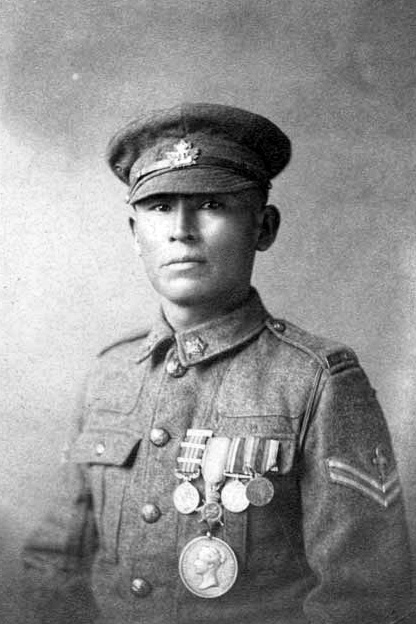
Francis Pegahmagabow was born on March 9, 1891, on the Parry Island Reserve in Ontario where he learned traditional skills such as hunting, fishing, and traditional medicine.
At the outbreak of World War I, Pegahmagabow volunteered for service with the Canadian Expeditionary Force in August 1914. In early October 1914 he was deployed overseas with the 1st Canadian Infantry Battalion of the 1st Canadian Division – the first contingent of Canadian troops sent to fight in Europe.
In April of 1915, Pegahmagabow’s company fought in the Second Battle of Ypres, where the Germans used chlorine gas for the first time on the Western Front. Following the battle, he was promoted to lance corporal. His battalion took part in the Battle of the Somme in 1916, during which he was wounded in the left leg. He received the Military Medal for carrying messages along the lines during these two battles.
In November of 1917, Corporal Pegahmagabow earned a Bar to his Military Medal for his actions in the Second Battle of Passchendaele. During the fighting, Corporal Pegahmagabow played an important role when the battalion’s reinforcements became lost. He helped lead the reinforcements to their allocated spot in the line.
During the Battle of the Scarpe in August of 1918, Pegahmagabow was involved in fighting off a German attack at Orix Trench near Upton Wood. His company was almost out of ammunition and in danger of being surrounded. Pegahmagabow braved heavy machine gun and rifle fire by going into no-man’s land and brought back enough ammunition to defend the position. For these actions he received a second Bar to his Military Medal.
World War I ended in November of 1918 and in 1919 Pegahmagabow returned to Canada. He was credited with killing 378 Germans and capturing 300 more. He was first awarded the Military Medal in 1916 and earned two Bars for his excellence as a sniper and scout in the battles of Ypres in 1915, Passchendaele in 1917, Amiens in 1918 and Second Battle of Arras in 1918. On discharge, he was also awarded the 1914–15 Star, the British War Medal, and the Victory Medal.
After the war, Francis Pegahmagabow became an advocate for Indigenous rights and self-determination. He died in August of 1952 at Parry Island, Ontario.